Horses rarely react without a reason. A small shift in posture, a quick head turn, a tightened muzzle, or a sudden pause often tells you more than a loud display ever could. What looks like a simple “trigger” from the outside is usually a horse responding to something in its environment, body, memory, or daily routine.
Understanding trigger patterns in horses means learning to notice what happens before the reaction, not only during it. The same horse may stay relaxed in one setting and become tense in another because the cue is different, the context changed, or the horse’s state of mind is already altered. That pattern matters more than the single moment people often focus on.
In daily handling, these triggers can appear in quiet ways first. A horse that was easy to groom yesterday may flinch at the same brush today. A horse that walks calmly into the arena one week may hesitate at the gate the next. The behavior is not random, and it is usually not personal. It is a response shaped by experience, comfort, and expectation.
What trigger patterns look like in everyday horse behavior
Trigger patterns are easier to understand when you watch the sequence rather than the isolated reaction. A horse may start by scanning the surroundings, then shift weight, pin one ear, tighten the neck, and only afterward show a bigger reaction such as stepping away or refusing to move forward. Those early signals are the key part of the pattern.
Some reactions are obvious. Others are subtle enough to miss unless you know the horse well. That is why the same situation can seem unpredictable at first. The horse is often showing warning signs long before the behavior becomes difficult.
Common early signals
- Raised head and fixed stare
- Frozen feet or delayed movement
- Tension along the neck or back
- Ears locking forward or backward
- Rapid tail swishing without obvious irritation
- Changes in breathing or chewing
- Sudden reluctance to approach a place or object
These signs do not always mean fear. Sometimes they point to uncertainty, irritation, anticipation, or mild discomfort. The important part is that the horse has noticed something and begun to respond before the reaction becomes bigger.
A trigger pattern is usually a chain: the cue, the horse’s internal response, and the outward behavior. If you only notice the last step, you miss the pattern that caused it.
Why horses become sensitive to certain triggers
Horses are built to notice detail. That sensitivity helps them stay safe, but it also means they can connect a place, sound, object, or handling pattern with a past experience. Once that connection forms, the horse may react before anything truly threatening happens.
Some triggers are linked to memory. A horse that was frightened by a tarp, trailer ramp, clippers, or a sudden drop in footing may react again when something similar appears. Other triggers come from repetition. If a horse expects pressure, pain, or confusion in a certain routine, the reaction can start before the routine even begins.
Body discomfort matters too. A horse with sore muscles, dental problems, a poorly fitting saddle, or general fatigue may have a lower tolerance for normal handling. In those cases, the trigger is not always the object itself. It is the horse’s reduced ability to cope with it.
Internal reasons behind the reaction
- Previous negative association
- Physical discomfort or pain
- Fatigue or mental overload
- High alertness in unfamiliar settings
- Need for social reassurance from herd mates
- Confusion about what is being asked
A horse that appears “sensitive” is often telling you that the system around it does not feel clear or comfortable. The reaction may be small, but the cause can be deep enough to repeat unless it is noticed early.
How trigger patterns show up in stable life
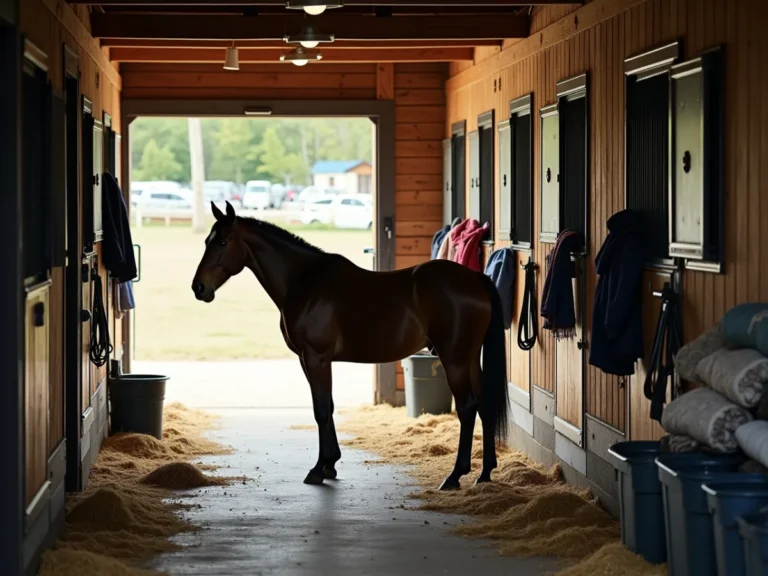
The stable is full of repeated cues, which makes it one of the easiest places to see trigger patterns. Horses learn the order of feeding, turnout, grooming, and stall routines very quickly. If something changes, even slightly, they may react to the difference rather than to the event itself.
A door that usually opens at a certain time, a bucket moved to a new spot, or a different person approaching the stall can all matter. Horses notice rhythm. When that rhythm changes, some horses stay flexible, while others become visibly tense or impatient.
Stable triggers often appear in ways people interpret as “bad manners,” but the pattern is usually more specific than that. A horse that crowds the door may not be pushy so much as anxious about missing feed. A horse that refuses to leave the stall may be responding to weather, soreness, or a bad association with the arena ahead.
Examples in the barn
- Hesitation at stall doors or cross ties
- Agitation during grooming in one specific area
- Restlessness when seeing the tack being carried in
- Calling out when herd mates are moved
- Resistance near wash racks, clippers, or the farrier area
When a horse reacts in the same place more than once, the location itself often becomes part of the trigger pattern. The horse is not only responding to the object in front of it, but also to the memory tied to that location.
Trigger patterns in the pasture and herd setting
In a pasture, horses often look more relaxed, but trigger patterns still show up clearly. The difference is that herd dynamics become part of the picture. A horse may react to separation, movement from another horse, changes in feeding order, or the approach of a dominant herd mate.
Some horses are strongly influenced by the emotional state of the group. If one horse spooks at a distant noise, another may react almost immediately. That does not mean every horse heard the same thing with the same intensity. It means herd awareness spreads quickly.
Pasture reactions can also reveal long-standing social habits. A horse that guards hay may have learned to worry about competition. A horse that moves away when a dominant companion approaches may be showing a mix of respect, caution, and habit. These responses can become patterned and predictable over time.
Situations that often matter in turnout
- Herd changes or new arrivals
- Moving from one field to another
- Limited hay or water access
- Unusual machinery near the fence line
- Separation from a preferred companion
- Weather shifts that make the environment feel different
What looks like a simple pasture tantrum can actually be a response to social pressure or environmental uncertainty. In a herd, trigger patterns are often shared, amplified, or redirected through the group.
How trigger patterns appear during riding
Under saddle, trigger patterns can be harder to read because the horse must balance movement, coordination, and communication at the same time. A horse that seems fine at the walk may tighten immediately when asked to trot past a certain object, enter a corner, or move into a new arena section.
Riding reactions often begin with small changes. The stride shortens. The back feels less swinging. The poll lifts. The horse stops listening as cleanly as before. Some horses speed up, while others slow down or refuse. The direction of the reaction depends on the horse’s temperament and the type of pressure it expects.
A horse that has learned to anticipate discomfort may react to the saddle, leg aids, rein contact, or even the route into the arena. Another horse may be fine once moving but tense during mounting. The trigger is not always the same from one ride to the next, which is why observation matters so much.
Riding contexts where patterns often repeat
- Entering the arena or leaving the barn alone
- Passing banners, mirrors, water, or shadows
- Riding near other horses or being left behind
- Cantering in a specific direction or corner
- Mounting from a block or the ground
- Changing tempo, frame, or rein feel suddenly
A horse may look obedient on the outside while still bracing against a trigger internally. That is why tension often appears first in the body before it appears in the behavior.
What the behavior may signal about the horse’s state
Trigger patterns can point to several different states, and the visible behavior alone does not tell the whole story. A horse may be anxious, confused, overexcited, sore, under-stimulated, or simply unsure of what comes next. The same outward reaction can come from very different causes.
For example, a horse that repeatedly drifts away from the mounting block may be nervous, but it may also be anticipating back pain or a poorly balanced rider. A horse that pins its ears when being tacked up may be irritated by the equipment, but it may also be signaling that the process feels rushed or uncomfortable.
That is why context is essential. What happened before the reaction? Did the horse rest well? Did the environment change? Was the horse already tense from turnout, transport, or a new herd mate? These details shape the meaning of the trigger.
One reaction can have many causes. The more often the pattern repeats in the same context, the more useful the context becomes for understanding it.
Possible meanings behind a trigger response
- Fear of a specific cue or place
- Physical discomfort or pain
- Overarousal from too much stimulation
- Frustration with unclear handling
- Learned anticipation of pressure
- Need for space, time, or reassurance
People sometimes look for one simple answer, but horses rarely work that way. Their reactions can be layered, especially when the same trigger has been repeated many times.
How subtle signals become stronger reactions
Most strong reactions start small. A horse that seems to “explode out of nowhere” usually gave earlier clues that were missed. Those clues may have been soft enough to blend into normal movement, especially if the horse was trying to stay controlled.
Subtle tension often builds when the horse feels it cannot leave, avoid, or understand the situation. If the warning signs are ignored, the horse may escalate to a stronger response such as bolting, rearing, striking, biting, or freezing. The escalation is not the first message. It is the last one.
This is why consistency matters. If a horse repeatedly shows the same early signs in the same setting, those signs deserve attention. Waiting for a big reaction usually means the horse has already been pushed past its easiest point of communication.
Soft versus strong signals
| Soft signal | Possible stronger progression |
|---|---|
| Brief stare at an object | Refusal to move past it |
| Neck tightens slightly | Head toss or abrupt spin |
| Weight shifts away | Pulling back or sidestepping hard |
| Ears flick repeatedly | Pinning, striking, or rushing |
| Shortened stride | Stopping, rearing, or bolting |
These changes do not happen in every horse, but they show how a mild trigger can build if the horse keeps feeling trapped or misunderstood.
How environment changes the meaning of a trigger
The same object can mean very different things in different places. A tarp on the ground in a quiet arena may trigger curiosity. The same tarp flapping near a trailer, beside a noisy fence, or after a stressful ride may trigger alarm. The horse is responding to the whole picture, not just the object.
Noise, footing, weather, light changes, and nearby movement all affect how a horse reads a situation. A horse that is already tense is more likely to react to a smaller cue. A horse that feels secure may ignore the same cue completely.
Routine also shapes sensitivity. Horses that know what to expect often handle small surprises better. Horses with changing schedules, inconsistent handling, or frequent interruptions can become more watchful. That watchfulness is not a flaw. It is a response to uncertainty.
Environmental factors that commonly influence triggers
- Echoing sounds in enclosed spaces
- Moving shadows, reflections, or bright patches
- Uneven footing or slippery ground
- Wind, rain, or weather pressure
- Unfamiliar objects placed suddenly nearby
- Traffic, dogs, machinery, or voices in the background
Some horses barely notice these changes. Others notice everything. The difference often comes down to temperament, past experience, and how safe the horse feels in that moment.
Why some trigger patterns are inconsistent
Owners often expect the same trigger to produce the same response every time. Horses do not always cooperate with that expectation. A horse may react strongly one day and stay quiet the next, even when the setup looks nearly identical.
That inconsistency usually has a reason. The horse may have rested better, felt less pain, had more turnout, or simply been in a calmer mental state. Another day, the horse may already have been on edge before the trigger appeared. Small differences can change the entire response.
This is why long-term observation is valuable. One event tells you little. A pattern across many days tells you much more. The more you notice the conditions around the reaction, the easier it becomes to separate a true trigger from a one-off mood shift.
Inconsistent reactions are still patterns when the surrounding conditions repeat. The horse may not be reacting to the same thing every time, but to the same combination of pressure, timing, and state.
How experienced horses can still show trigger patterns
Experience does not erase trigger patterns. It often changes them. A mature horse may no longer spook dramatically, but it may show smaller signs of caution, avoid certain places, or become tense in specific routines it has learned to distrust.
Well-trained horses often hide their discomfort longer than young horses. That can make their trigger patterns harder to notice. Instead of visible resistance, you may see reduced expression, flattened movement, or a careful, guarded way of going through the task.
Some older horses also develop stronger patterns because they have had more time to link events together. A horse that has spent years in work, transport, or repeated handling may have a long memory for both good and bad experiences. That history shapes what it expects next.
Signs that a horse has learned a trigger over time
- Hesitation before contact is even made
- Predictable tension in the same environment
- Avoidance of familiar equipment or locations
- Quiet resistance instead of obvious spooking
- Change in expression before the task begins
Experienced horses may not look dramatic, but their patterns can be very clear once you know where to watch.
Reading the horse without forcing a single meaning
The most useful way to understand trigger patterns is to stay curious. One reaction can mean several things, and the best answer usually comes from noticing the full sequence: what happened before, what the horse did, and how often the same pattern returns.
That approach keeps the horse’s experience at the center. Instead of labeling behavior too quickly, you start to see the structure beneath it. A horse that reacts at the gate, in the trailer, or during saddling may be telling a consistent story about pressure, expectation, or discomfort. The details matter.
When the pattern is recognized early, handling becomes more thoughtful. The horse has a better chance to stay below the point of escalation, and the trigger itself becomes easier to understand in future situations. The reaction is no longer just a surprise. It becomes information.
That information is often already there in the posture, the timing, and the small pauses between movement. Horses speak in those pauses first.
Once those signals become familiar, trigger patterns stop looking random. They begin to make sense as part of the horse’s everyday way of responding to its world.