Escalating behavior during routine activities often starts in a way that is easy to overlook. A horse may seem a little sharper than usual during grooming, step away once or twice while being tacked up, or lose patience in a quiet moment that normally feels uneventful. The change can be subtle at first, then more obvious the next day, and then suddenly become part of a pattern that shows up in the same places again and again.
What makes this kind of behavior confusing is that it often appears around ordinary tasks. Nothing dramatic is happening. The horse is not in a new place, not doing anything hard, and not facing an obvious threat. Yet the response grows stronger over time. A routine that once felt predictable can begin to include tension, resistance, or agitation.
That shift matters because routine activities are where many small stresses collect. Horses notice details people barely register: the timing of feed, the order of handling, a change in the barn mood, a tighter girth, a hand moving too quickly, or the sound of tools in the aisle. When those small pressures build, escalation can show up before anyone identifies a clear cause.
How escalating behavior appears in everyday handling
Escalation during routine work rarely begins with a dramatic reaction. More often it starts with a small refusal, a distracted ear, a tighter neck, or a horse that seems less willing to stand still than usual. If the pressure continues, the reaction may grow into pawing, swinging the hindquarters, pinning the ears, moving away from touch, or becoming harder to lead.
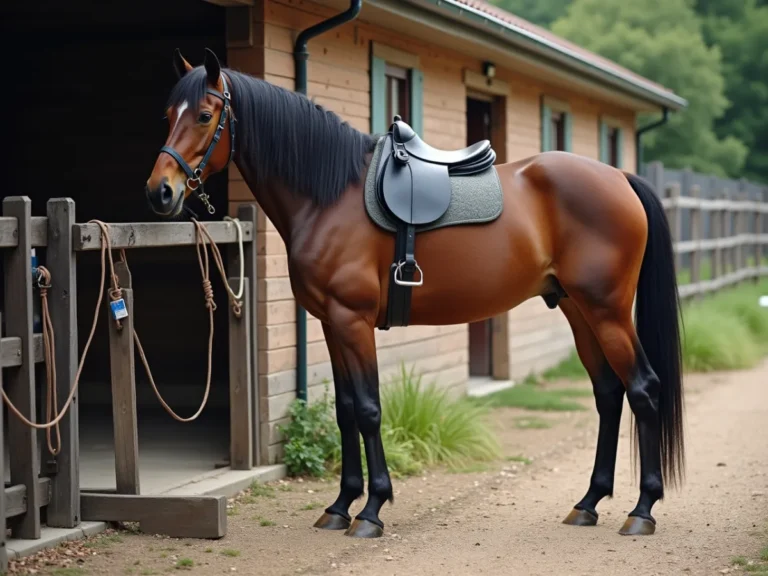
In grooming, the first sign may be a horse shifting weight repeatedly or reacting to a brush that used to be tolerated. In tacking up, it may be a tightened belly, a lifted back, or a sudden step when the saddle pad is placed. During leading, escalation can look like speed changes, shoulder pushing, crowding, or a horse that starts testing the handler’s boundaries in small ways.
These are not always signs of defiance in the simple sense. Often they are messages about discomfort, anticipation, confusion, or stress. The important part is not just the behavior itself, but the way it builds from one response to the next.
Escalation usually means the horse feels something is unresolved. The first signal is often mild; the later signal is louder because the earlier one did not change the situation.
Common examples in routine settings
- Hesitation at the stable door before turnout or return
- Increasing fussiness during grooming in the same body area
- Calling out, pacing, or gripping the jaw before feeding time
- Repeated moving away during haltering or bridling
- Becoming more reactive around one specific grooming tool or handler action
- Standing quietly at first, then escalating once the routine continues
Why routine can become the trigger
Routine is usually comforting for horses, which is why changes inside routine are so meaningful. A horse learns patterns quickly. If breakfast comes at the same time, handling follows the same order, and turnout always happens through the same gate, the horse begins to predict what comes next. That prediction can be calming, but it can also make the horse sensitive to anything that feels different.
Escalation often appears when a familiar routine no longer feels fully predictable. Maybe the handler is rushed. Maybe the grooming order changed. Maybe the saddle fit shifted slightly, or the horse has become sore in a way that was not obvious yesterday. Even small inconsistencies can matter because horses notice pressure, timing, and repetition very closely.
Daily life can also create anticipation. A horse that expects work, a trailer ride, stall confinement, pasture separation, or a physically demanding task may begin to react before the activity even starts. In that case, the routine itself becomes the cue, not just the event that follows.
Environmental factors that quietly increase reaction
- Noise in the barn aisle or nearby equipment
- Different turnout companions or herd movement
- Weather changes that affect comfort, insects, or footing
- A barn schedule that is delayed or rushed
- New smells, objects, or stored equipment near familiar spaces
- Changes in bedding, feed texture, or water availability
These things may seem small, but they can stack up. A horse that is already mildly unsettled is more likely to react strongly when several minor stressors appear together.
Possible internal reasons behind the reaction
Escalating behavior is often easier to understand when it is viewed as a response to internal pressure rather than a single bad moment. Discomfort is one common reason. A horse with a sore back, tight muscles, dental issues, skin irritation, hoof pain, or digestive discomfort may tolerate routine at first, then become increasingly defensive as handling continues.
Another factor is emotional arousal. Some horses are naturally more alert, and that alertness can turn into frustration when they are asked to stay still, accept repeated touch, or remain in a confined space. Others become concerned when they cannot see or control what is happening around them. The behavior escalates because the horse is trying to manage a feeling that keeps growing.
Learning history matters too. If a horse has repeatedly had unpleasant experiences during grooming, saddling, clipping, clipping noise, or being separated from other horses, the routine itself may trigger a stronger reaction before the actual discomfort begins. The horse may be reacting to memory as much as to the present moment.
Internal causes that are worth considering
- Pain or physical discomfort
- Anticipation of something unpleasant
- Frustration from feeling trapped or delayed
- Overstimulation from too much activity nearby
- Fatigue, hunger, or low tolerance after a long day
- Learned reactions from past experiences
When behavior escalates in a routine setting, the question is not only “What did the horse do?” It is also “What changed inside the horse before the response became obvious?”
How the body often speaks before the behavior grows stronger
Escalating behavior usually has a physical shape long before it becomes a clear problem. The ears may flick back more often. The eyes may look harder or more fixed. The head may rise slightly. The neck can become rigid. A horse may breathe more shallowly, hold the jaw tight, or shift weight in a way that suggests waiting rather than resting.
Small changes in posture are easy to miss because they do not look dramatic. Yet they often tell the story before the more obvious reaction appears. A horse that is about to escalate may stop relaxing through the topline, narrow its focus on a person or object, or begin moving in a way that looks restless rather than curious.
Some horses show a freeze before they show resistance. Others become busy and noisy. Both can be part of the same escalation pattern. A horse that stands very still with a tense body is not always calm. Stillness can also be the point just before a stronger reaction.
What people often misunderstand
Routine behavior is easy to misread because the setting makes it seem harmless. If a horse reacts during a normal chore, people may assume the horse is being stubborn, spoiled, or dramatic. Sometimes that interpretation leads to a stronger response from the handler, and the interaction becomes more tense instead of less.
Another common misunderstanding is assuming the horse is reacting to the whole task when only one part of it is uncomfortable. A horse that resists saddling may actually be reacting to the pad, the girth, the back pressure, or the moment the handler pauses too long. A horse that fusses during grooming may dislike pressure over one sore spot rather than grooming itself.
It also helps not to assume that a horse is simply “testing” people every time behavior escalates. Horses do learn what gets them relief, but a repeated response often means the horse has found a strategy that works, not necessarily that the horse is being oppositional in a human sense. The distinction matters because it changes how the situation should be read.
Signals that are often mistaken for attitude
- Standing off-center when being handled
- Moving the shoulder into space instead of away from pressure
- Refusing to lower the head for haltering
- Becoming mouthy or fussy during tack placement
- Repetitive tail swishing in a task that usually feels easy
- Quickly shifting from quiet patience to clear resistance
How the environment shapes the intensity
Some horses escalate only in certain places. The same horse may stand quietly in the wash rack but react strongly in the cross-ties. Another may be relaxed in the pasture but agitated when brought into the aisle. These differences are useful because they point to context, not just temperament.
In a stable, close quarters and limited movement can increase tension. In an arena, open space may help one horse relax but make another more aware of movement and noise. During transport, the combination of confinement, motion, and separation from familiar surroundings can turn a mild concern into a larger response very quickly.
Human behavior also affects the horse. A person who is hurried, inconsistent, or physically tense may accidentally add pressure to an already sensitive horse. A quiet, predictable approach often reduces the chance that a small concern will grow into a bigger one.
| Setting | Common trigger | Typical escalation pattern |
|---|---|---|
| Stable | Noise, confined space, routine delays | Restlessness, pinned ears, moving away |
| Field | Herd changes, separation, feed timing | Calling, pacing, guarded posture |
| Riding area | Pressure, repeated requests, unfamiliar work | Tension, resistance, quicker reactions |
| Transport | Motion, confinement, separation | Sweating, scrambling, vocalizing, refusal |
Each setting brings its own pattern. When the same horse behaves differently across spaces, that difference is a clue, not a contradiction.
When escalation appears in feeding, turnout, and daily care
Feeding time is one of the most common moments for escalation because the horse’s expectation is high. A delay in grain, hay, or turnout can create pacing, calling, fence walking, or pushy behavior at the gate. Sometimes the horse is not “hungry” in the simple sense; the real issue is frustration when an expected routine does not happen on time.
Turnout and return can also bring tension, especially if the horse dislikes herd changes or feels rushed in the aisle. A calm horse may become more reactive when another horse leaves, when the weather changes, or when the day’s routine gets disrupted. Grooming and hoof care can show the same pattern, especially if the horse has learned that those activities often include pressure, confinement, or discomfort.
Daily care can reveal problems because it repeats. A horse that tolerates an uncomfortable situation once may not be able to tolerate it every day. Repetition is what often makes the escalation visible.
What consistent escalation may be telling you
When the same behavior keeps appearing in the same routine, the pattern deserves attention. Consistency usually means there is a stable trigger, even if the trigger is not obvious. It may be pain. It may be fear. It may be a specific part of the handling process that the horse finds difficult. It may also be a combination of things that only seems minor when viewed one at a time.
Notice whether the behavior is tied to a particular person, place, time of day, or task. A horse that only escalates before exercise may be anticipating work that feels physically uncomfortable. A horse that reacts only in the evening may be dealing with fatigue, boredom, or a change in barn activity. A horse that reacts only with one handler may be responding to timing or body language that feels harder to understand.
Tracking the pattern is often more useful than reacting to the last incident alone. The first clear sign may be useful, but the repeated context is what reveals the real shape of the problem.
Questions that help identify the pattern
- Does it happen at the same time each day?
- Does the reaction begin before the task starts?
- Is one body area more sensitive than others?
- Does the horse settle once the activity ends?
- Does the reaction increase with repetition?
- Has anything changed in feed, tack, weather, or workload?
How horses often move from mild tension to stronger reaction
The shift from mild tension to stronger behavior is rarely sudden in the horse’s mind, even if it looks sudden to people. The horse may have been tolerating a situation for a while, then reaches a point where the pressure feels too high. Once that point is reached, the response can appear larger than expected because it is the result of everything that came before it.
This is why escalation should not be judged only by the final behavior. A horse that bites, strikes, bolts, or resists forcefully may have given several quieter signals first. Those early signs are often the most practical ones to notice because they appear sooner and are easier to work with.
Some horses also build pressure in a stepwise way. They begin with a look, then a shift, then a refusal, then a more obvious protest. Others jump straight to a stronger response if the trigger is especially meaningful. Both patterns matter, and both can happen in the same horse depending on the situation.
The strongest reaction is often the last part of a longer conversation. Earlier signals usually carry the more useful information.
Natural pattern, modern routine
Horses are built to stay aware of their surroundings, and that awareness never disappears in a domestic setting. In the wild, alertness helped them stay safe. In modern life, that same alertness can show up during common chores, especially when the horse feels trapped between routine expectations and a discomfort it cannot escape.
Stable life adds new kinds of pressure. Horses are asked to stand still, accept handling, remain separated from herd mates, and adjust to human schedules. Many horses handle that well. Others are more sensitive to changes in routine or more easily overwhelmed by repeated requests. Escalating behavior is often the point where that internal pressure becomes visible.
When routine activities seem to bring out more reaction than they used to, it usually means the horse’s experience of the routine has changed. The change may be physical, emotional, or environmental. Often it is all three in small amounts.
Closing thought on recurring escalation
A horse that escalates during routine care is giving useful information, even when the behavior looks inconvenient. The pattern usually shows where the horse feels uncertain, uncomfortable, or pushed past a manageable level. In many cases, the routine itself is not the problem; the details inside it are.
Noticing where the reaction begins, what makes it grow, and when it appears most often can change the entire picture. A quiet change in body language during grooming, a tighter posture at feeding time, or a repeated refusal in one familiar spot may be the earliest part of a much bigger story. That is often where the clearest answer is waiting.
Over time, the routine stops looking like a simple daily task and starts looking like a map. The horse follows that map every day, and the small changes in behavior show exactly where the path has become harder to walk.