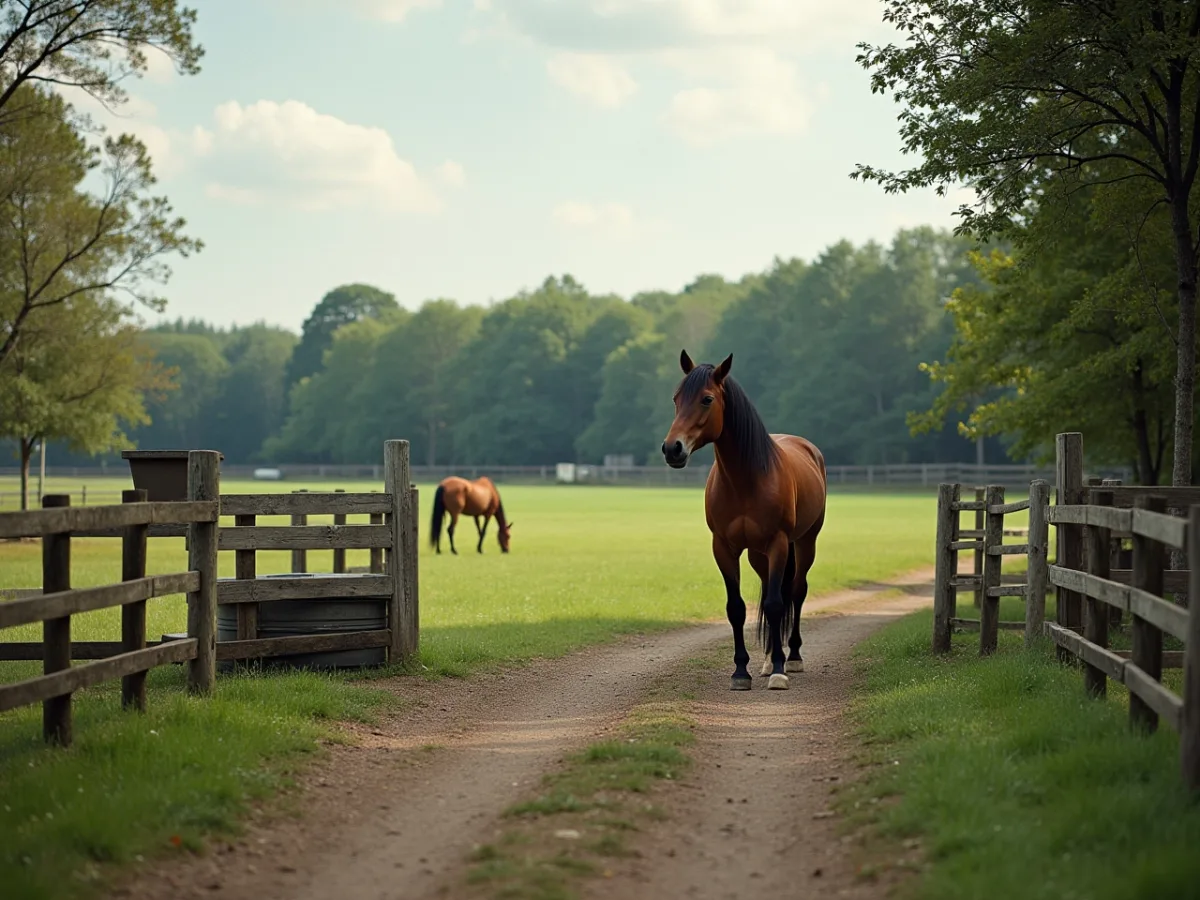
Seeing a horse leave the group, head for the fence line, or drift toward the far side of a field can feel unsettling fast. A horse that seems eager to get away is not always being difficult, and the reason is often more practical than personal. Distance, pressure, boredom, uncertainty, and habit can all shape that response.
In many cases, what looks like a horse “trying to get away” is really a horse trying to manage its own comfort. Some horses move off because they are curious. Others do it because the current area feels too exposed, too busy, or too controlled. The field itself, the herd around them, and the way people approach all matter.
Owners often notice the pattern most when a horse becomes harder to catch, faster to leave, or more intent on staying at the edge of the pasture. That behavior can be mild or very persistent. It can appear in young horses, older horses, herd-bound horses, or animals that simply have learned where the easiest option is.
What “being caught in the field” usually looks like
The behavior is not always dramatic. Sometimes a horse only steps away when a halter appears. Other times the horse keeps a constant safe distance, watches the person closely, and moves just enough to avoid being reached. In bigger fields, the horse may use space itself as a shield.
Some horses behave this way only with certain people. Others do it during feeding time, after turnout changes, or when the weather shifts. A horse may seem relaxed until the moment a person enters the pasture, then become suspicious and mobile. That change is often the most useful clue.
Common signs owners notice
- Turning the head away when a person approaches
- Walking off at an easy but steady pace
- Standing just out of arm’s reach
- Moving toward other horses instead of toward the handler
- Drifting to the far end of the field when called
- Watching the person but not fully relaxing
These signs do not all mean the same thing. A horse that steps away calmly is different from one that bolts, pins ears, or keeps tension through the neck and body. The context matters more than the motion alone.
A horse that avoids being caught is often responding to past experience, current pressure, or the value of what happens next.
Why horses develop this pattern
Horses are quick to connect patterns. If being caught usually means work, confinement, stress, or discomfort, many horses start making themselves harder to catch. That does not make them stubborn in a simple sense. It often means they have learned that distance helps them control the next event.
There is also the basic horse instinct to stay aware of what is happening around them. In the open field, a horse can choose movement as a first response to uncertainty. If the pasture feels busy, windy, noisy, or too open, leaving the immediate area can feel safer than standing still and waiting.
In some horses, the habit is reinforced without anyone noticing. If a horse is only approached for unpleasant events, avoidance becomes more likely. If the horse is caught roughly, rushed, or separated from herd mates every time, the field itself can start to feel like the place to keep distance.
How herd dynamics change the picture
Horses rarely make decisions in isolation. The herd nearby can make a horse easier or harder to catch. A horse that feels secure with companions may stand quietly. A horse that is low in the group may move away when another horse shifts position, because it is already used to yielding space.
Herd-bound horses are a different case. They may resist being caught because leaving the group is what feels uncomfortable. The issue is not the halter itself. It is the social separation that follows. In that setting, the field becomes the place where the horse can stay close to the herd and avoid the stress of leaving.
Sometimes the opposite happens. A horse may move away from certain horses and seem easier to catch only when the social pressure drops. That is why one pasture can produce very different behavior depending on who is turned out together.
Herd factors that affect catchability
- Rank and pressure from other horses
- Attachment to one specific companion
- Competition at hay, water, or mineral sources
- Recent changes in turnout group
- Whether the horse feels isolated or crowded
If a horse seems harder to catch after a herd change, the behavior may be about social comfort rather than handling alone.
What the field itself can influence
A horse does not experience every field the same way. A small paddock with one gate and frequent traffic creates a different emotional setting than a large, quiet pasture with hills, trees, and several exit points. Visibility, footing, weather exposure, and escape options all shape how willing a horse is to stay near a person.
Open space can make a horse feel both safer and more able to choose distance. In a wide field, walking away is simple. In a narrow pen, the horse may not have that option and may instead show more obvious tension. That is why the same horse can seem manageable in one place and nearly impossible in another.
Weather matters more than many people expect. Wind can increase alertness. Rain or snow can alter footing and make a horse less patient with being approached. Strong sun, flies, and heat can also make movement more appealing than standing still for an unfamiliar interaction.
How people accidentally make the pattern stronger
Very often, the human side of the interaction is part of the story. Directly walking at a horse, especially a cautious one, can feel pressuring. If the horse steps away and the person follows without pause, the horse gets more evidence that moving off works.
Some horses learn to read the rhythm of the person entering the field. Boots in the grass, a lead rope in hand, a determined pace, or repeated calling from a distance can all become part of the pattern. Horses notice those details quickly. They do not need a formal lesson to understand that certain cues predict being caught.
Timing also matters. If every catch ends with a stressful grooming session, an uncomfortable blanket change, or a hard workout, the horse may begin to avoid the whole process. On the other hand, if catching often leads to quiet attention, feed, or a pleasant routine, the horse is less likely to treat the field as a place to flee from.
Handling patterns that can increase avoidance
- Approaching too quickly or directly
- Chasing after a horse that has already moved off
- Using the same predictable route every time
- Ending every catch with a stressful or painful experience
- Allowing the horse to “win” by escaping after repeated pressure
None of these create the behavior by themselves. But repeated patterns can deepen it. Horses are extremely good at linking small details to outcomes.
What the behavior may signal about the horse’s state
A horse avoiding being caught can be saying several different things. It may be nervous. It may be uncomfortable. It may be bored and looking for control. It may also simply be healthy, alert, and aware of the route of least resistance. The same outward behavior does not always mean the same internal state.
Physical discomfort is worth keeping in mind. Horses that feel sore, have dental issues, are sensitive to saddle pressure, or dislike being touched in a certain area may become much more avoidant. If the horse is easy to catch on rest days but difficult on work days, discomfort should stay on the list of possibilities.
Emotional discomfort can look similar. A horse that is worried, over-aroused, or unsure of the handler may avoid contact without showing dramatic fear. This can appear as head tossing, tight muscles, an elevated neck, or a body angle that keeps the horse ready to move.
A change in catch behavior is often more informative than the behavior itself. A sudden shift can point to discomfort, stress, or an environmental change.
Subtle signals that often come before moving away
Before a horse leaves, the body usually speaks first. The horse may pause, shift weight, focus an ear, or turn just enough to keep the person in sight. These are small things, but they matter. A horse that is thinking about leaving often shows it before the feet actually move.
Look for tension through the jaw, a tighter topline, or a tail held more firmly than usual. Some horses freeze for a beat, then walk off. Others begin with a small step, then gradually lengthen the distance. That gradual increase is common because it lets the horse stay in control.
Body language that can accompany avoidance
- Head held higher than normal
- One ear toward the person, one ear scanning elsewhere
- Repeated shifting of hind feet
- Brief pause followed by a quick walk away
- Body angled so the horse can leave easily
- Stiffness around the muzzle or eyes
These signs do not require panic, but they do call for patience. A horse that feels watched or cornered often becomes less cooperative, not more.
Calm avoidance versus reactive avoidance
There is a difference between a horse that politely keeps space and one that actively resists. Calm avoidance tends to look smooth, measured, and consistent. The horse may move away, but without rushing or carrying obvious stress through the body.
Reactive avoidance is sharper. The horse may spin, surge forward, toss the head, pin the ears, or show sudden changes in speed. That version usually means the horse is not merely deciding to stay out of reach. It is responding to pressure, fear, or conflict.
Understanding the difference helps owners respond more appropriately. Calm avoidance often improves with quieter approach habits and better predictability. Reactive avoidance often needs a closer look at the horse’s comfort, the handling history, and the environment around the catch.
| Type of behavior | Common look | What it may suggest |
|---|---|---|
| Calm avoidance | Stepping away, keeping distance, watching closely | Preference for control, learned habit, mild uncertainty |
| Reactive avoidance | Quick movement, tension, head tossing, pinned ears | Stress, fear, discomfort, strong negative association |
How routine shapes field behavior over time
Daily patterns make a big difference. Horses know when feed arrives, when turnout ends, and when work usually begins. If a horse only gets caught right before the hardest part of the day, the field quickly becomes linked with that outcome. If the routine is irregular, the horse may become even more watchful because it cannot predict what comes next.
Some horses are easiest to catch after a predictable routine has settled in. Others become more difficult when the schedule changes, even slightly. A different handler, a different halter, or a later-than-usual turnout pickup can be enough to trigger the pattern.
The useful part of this is that routine can also support better behavior. Horses often settle when the handling pattern becomes calmer, more consistent, and less abrupt. That does not mean every horse will love being caught. It means many horses do better when the experience feels less random.
Long-term patterns worth watching
If the behavior stays the same for years, it may simply be a learned preference for distance. If it changes, the change deserves attention. A horse that becomes much harder to catch after a move, a herd change, a hoof issue, or a change in work load may be telling you something specific.
Consistency is important. A horse that avoids being caught only in one field, only in one season, or only after certain events is giving clues. Those patterns help separate habit from a larger problem.
Long-term observation also shows what improves the horse’s response. Some horses settle when the handler becomes quieter. Some respond better when they are caught for brief, low-stress interactions that do not always end in work. Others need management changes because the real issue is discomfort or social stress.
When the pattern changes, pay attention to what changed first: the horse, the routine, the herd, or the field.
Practical ways owners think about the problem
Most owners want the same thing: a horse that can be caught without a long struggle. The starting point is usually not force. It is understanding what the horse is avoiding. That may be the handler, the separation from friends, the expectation of work, or the memory of a negative experience.
It helps to think in terms of comfort and predictability. Horses are more willing to stay put when the approach is unhurried and the next step does not feel harsh. Some horses need a quieter approach path. Others need a review of pain, tack fit, turnout setup, or herd placement.
The field is not just a place where the horse happens to live for a while. For many horses, it is where they make decisions about safety, social connection, and control. A horse that avoids being caught is often making a clear choice based on those concerns.
When the behavior deserves a closer look
Not every horse that walks away has a problem. But certain changes should make an owner pay closer attention. A horse that suddenly becomes much harder to catch, seems worried while doing it, or begins avoiding specific people should not be brushed off too quickly.
It is also worth looking more closely when the horse’s movement away looks awkward, uneven, or guarded. That can point to soreness or another physical issue. If catching becomes difficult only after the horse starts a new job or gear changes, the field behavior may be the earliest visible sign.
Even when the behavior is old and familiar, it still has meaning. Horses do not keep repeating useful habits for no reason. They repeat what works, what feels safer, or what has been reinforced over time. The field simply gives them room to show that clearly.
In everyday life with horses, distance is communication. Sometimes it is mild. Sometimes it is a protest. Sometimes it is the horse’s way of saying that something about the situation does not feel worth accepting right now. Reading that message well begins with noticing how, when, and why the horse chooses to move away.