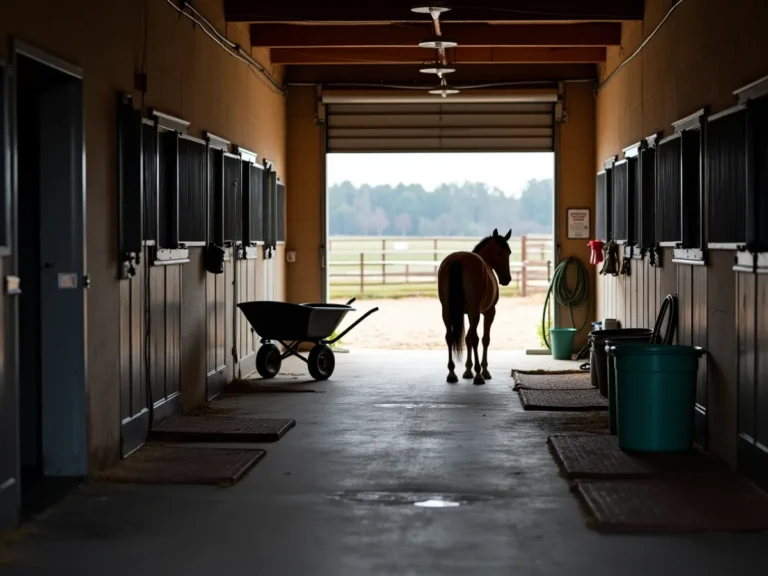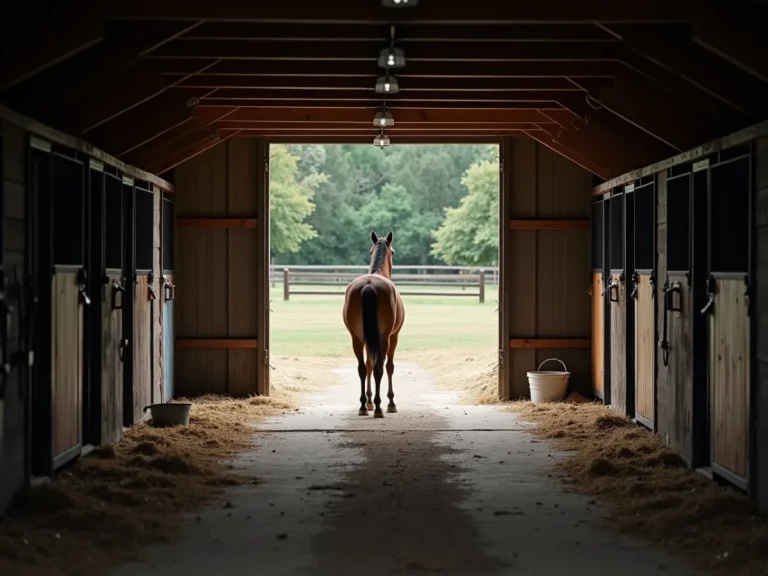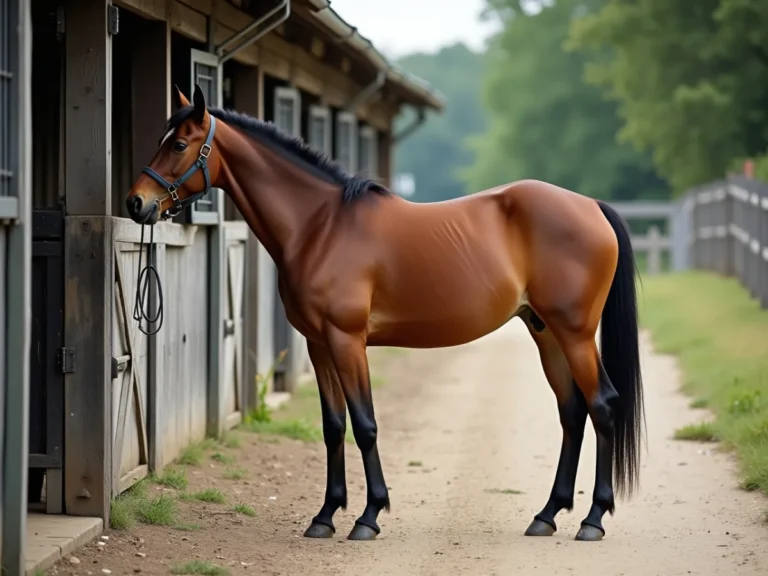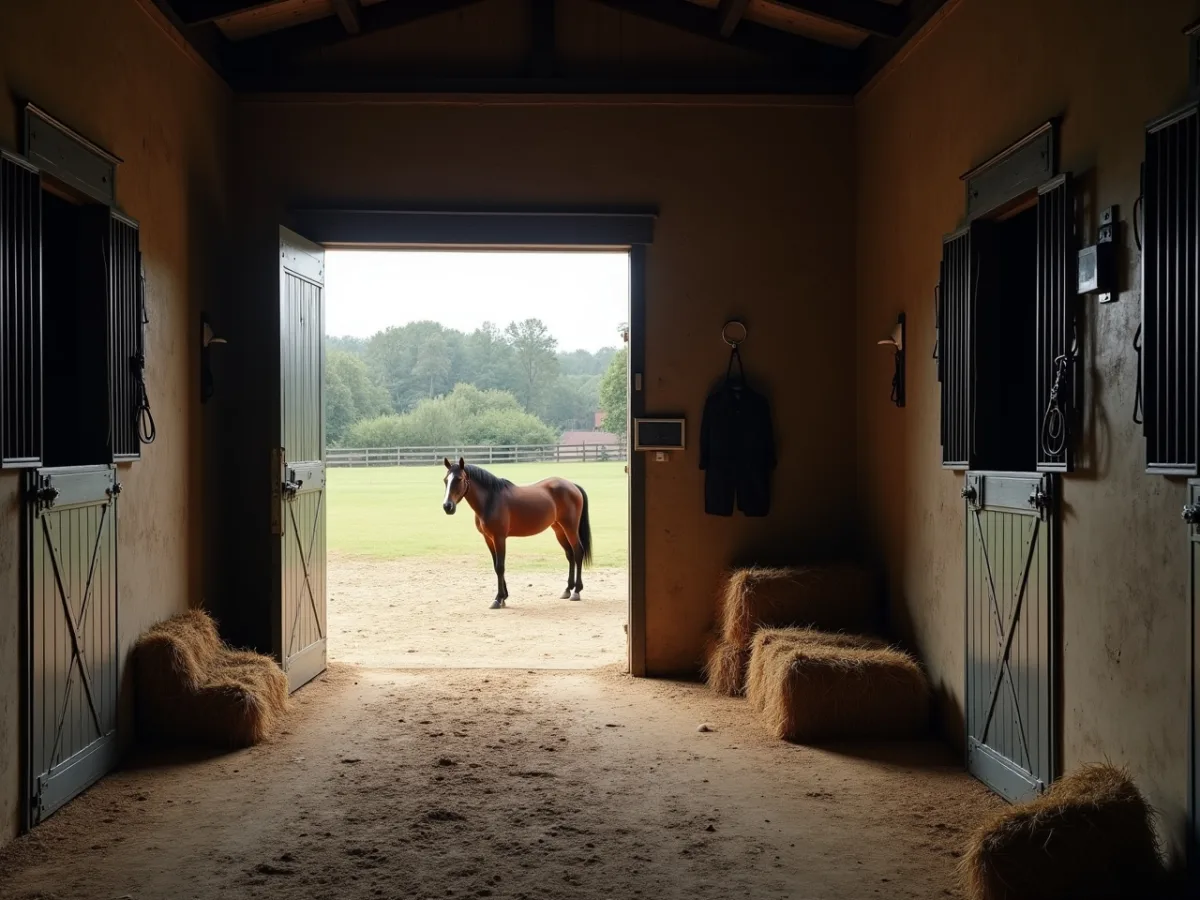
A horse that stops at the stable door is rarely being stubborn for the sake of it. More often, the refusal is a reaction to something the horse notices, remembers, or does not like about the space. The behavior can look simple from the outside, but the reasons behind it are often layered.
Sometimes the horse plants its feet and refuses to walk in. Sometimes it enters, then backs out, sweats, calls, or keeps shifting near the doorway. The pattern matters. A horse that will not stay inside may be reacting to light, noise, confinement, isolation, pain, routine change, or a past bad experience that still feels relevant to it.
Stables are not neutral places to horses. They change the horse’s sense of control, movement, social contact, and ability to choose distance from things it does not trust. That is why refusal to enter or stay in a stable can mean very different things depending on the horse, the day, and the environment around it.
Why a stable can feel wrong to a horse
Horses are highly aware of their surroundings. They read air movement, sounds, smells, shadows, footing, and the presence or absence of other horses. A stable compresses all of that into a small, enclosed space with limited exits. For a relaxed horse, that may be fine. For a cautious one, it can feel restrictive.
The most obvious reason for resistance is discomfort. A horse may dislike the bedding, the smell of ammonia, the temperature, the darkness, or the feeling of being boxed in. If the stall is hot and still, or damp and drafty, the horse may prefer almost anything else.
Another common reason is association. If the stable has been linked to injections, veterinary work, isolation, painful grooming, or long hours with little movement, the horse may learn that entering the stall predicts something unpleasant. Horses do not need a dramatic event to build that connection. Repetition is enough.
Refusal to enter or remain in a stable is often less about defiance and more about the horse trying to control distance, comfort, and safety.
What the behavior looks like in real life
Some horses show a clear stop at the door. They lean back, brace, widen their stance, and refuse to step over the threshold. Others seem willing at first, then tense up once inside. A horse may walk in but keep its head high, ears moving, and hind feet ready to leave. It is in the stable, but not settled.
There are also horses that enter calmly and then begin to pace, paw, call out, or repeatedly turn to face the door. These horses are not always rejecting the stall itself. Sometimes they are protesting separation from herd mates. Sometimes they are uneasy about the lack of movement. And sometimes they simply know what happens next in that place.
The same horse can act differently from one day to the next. A horse that stays quiet in daylight may become upset at night. A horse that tolerates the stall when another horse is nearby may panic when left alone. That change is useful information, not random moodiness.
Common forms of refusal
Flat refusal at the entrance
This version is the most straightforward. The horse stops at the threshold and will not go in. It may back away, swing its head, or shift weight behind. The door frame itself may be the problem if the opening feels narrow, dark, or slippery underfoot.
Entering but not settling
Some horses step inside but keep looking out. They may stand with their neck stretched toward the aisle or the yard, as if ready to leave at once. This can happen with horses that dislike isolation or horses that expect work, feeding, or separation to follow.
Restlessness after entry
A horse may enter willingly and then start pawing, calling, weaving, or spinning. In these cases, the refusal is not at the door but in the stay. The horse is saying, in its own way, that the stall does not feel acceptable for long.
Escape behavior
When a horse pushes out, jumps sideways, or rushes through the doorway, the issue may be fear rather than reluctance. Tight spaces, sudden movement, or harsh handling can turn a simple transition into a defensive reaction.
Internal reasons behind the reaction
Fear is one of the first things people think about, and often for good reason. A horse may be worried about being trapped, about separation from companions, or about being unable to move away from a perceived threat. Even if the threat is only a loud fan, a flapping sheet, or a sharp smell, the horse experiences the worry as real.
Pain is another major factor. A horse with sore joints, back discomfort, hoof pain, or a developing illness may resist entering a stall because standing still makes the body feel worse. If the floor is hard, the bedding uneven, or turning around difficult, the stall can become an uncomfortable place very quickly.
Some horses resist because of frustration. A horse that spends much of the day in turnout may find stall time boring and confining. That is especially true for horses that are naturally active, social, and quick to notice changes in routine. Their refusal may reflect pent-up energy as much as anxiety.
Then there is memory. Horses remember places and routines. A horse that had colic, a trailer incident, a frightening injection, or an aggressive stall neighbor may respond to the stable with caution long after the event is over. The horse may not relive the event in words, but it often behaves as if the place still carries the same risk.
How environment changes the response
The stable itself can make a big difference. Good airflow, dry bedding, enough light, and a quiet layout can help a horse relax. A cramped aisle, loud banging doors, and poor visibility can do the opposite. Even details like a mirror, a hanging coat, or a hose left near the doorway can matter to a watchful horse.
The position of the stall matters too. Some horses are happier near other horses, while others are unsettled by passing traffic or noise from the feed room. A horse that is comfortable in one stall may reject another because the view changed or the neighboring horse is unfamiliar.
Weather and season also affect behavior. In hot weather, a closed stable can feel stifling. In winter, a dark stall may feel less inviting than the cold air outside. Strong wind, rain on the roof, or sudden temperature shifts can make a horse more reactive at the threshold.
Routine plays its part as well. If a horse is usually brought inside at a certain time and then expected to wait for long periods, it may begin resisting that pattern. The refusal may have less to do with the building itself and more to do with what happens after the horse goes in.
What the behavior may signal about the horse’s state
A horse refusing the stable is giving useful information about its current state. The message might be simple: the horse wants to stay with the herd. It might also be telling you that it is uncomfortable, bored, unsettled, or in pain.
Body language helps sort out the possibilities. A horse that is alert but loose may be socially motivated. One that is tense through the back, tight in the mouth, or quick to startle may be anxious. A horse that keeps shifting weight, walking stiffly, or pinning its ears when asked to turn may need a physical check.
Timing can be revealing. If the horse only refuses after exercise, fatigue or soreness may be involved. If the horse only resists at night, the issue may be reduced visibility or isolation. If the behavior started suddenly, a health or environmental change is more likely than a long-standing habit.
Sudden resistance is worth attention, especially when it appears with stiffness, sweating, tail clamping, vocalizing, or a clear change in appetite or movement.
How people often misread the behavior
It is easy to label the horse as difficult. That label usually hides the real question: what has changed, and what is the horse trying to avoid? Horses do not refuse a stable because they want to challenge the handler. They refuse because something in that moment makes staying inside feel less safe or less comfortable than leaving.
Another common mistake is assuming all refusal means separation anxiety. While herd attachment can be part of it, not every horse that resists a stall is panicked about being alone. Some horses are reacting to pain, temperature, noise, or a bad association with the stall itself.
It is also easy to overlook subtle signs. A horse may look calm but remain strangely fixed on the doorway, keep one hind leg ready to move, or stop chewing as soon as it is inside. Those details can matter as much as dramatic behavior. Quiet tension often comes before louder resistance.
Stable refusal in young horses
Young horses often dislike the stable because it is full of first experiences. The sounds are new, the walls are close, and the routine can feel confusing. A colt or filly that has mostly lived outdoors may not yet see the stall as a normal resting place.
Young horses are also more likely to test boundaries simply because they have not fully learned the pattern. That does not mean they are being disrespectful. It means their comfort with the space is still developing. A calm, predictable routine often matters more than force.
If a young horse enters but will not stay, the issue may be too much pressure too soon. Short, peaceful periods inside with a familiar companion nearby can help. So can making sure the stall itself is quiet, dry, and not overloaded with unfamiliar objects.
Stable refusal in mature horses
An adult horse that suddenly starts refusing the stable deserves closer attention. Mature horses are usually more consistent in their preferences, so a new refusal often signals a change in comfort or confidence. Pain, aging, loss of herd mate, altered turnout, or a change in stable management can all trigger it.
Older horses may object because standing inside feels harder on the body. They may dislike slippery floors, deep bedding, or a stall layout that makes turning awkward. What looks like a behavior issue can be a physical limitation.
Mature horses can also develop strong expectations. If a horse has spent years in a certain routine, even a small shift may unsettle it. A different feeding time, a new neighbor, or a moved hay net may be enough to create hesitation at the door.
Calm resistance, neutral reluctance, and stress-related refusal
| Type | What it may look like | What it may mean |
|---|---|---|
| Calm resistance | Slow steps, mild hesitation, looking back at turnout or herd mates | Preference for company or movement, not necessarily fear |
| Neutral reluctance | Repeated stopping at the door, but no strong panic | Uncertainty, dislike of routine, mild discomfort, or low motivation |
| Stress-related refusal | Backing up, sweating, rushing out, vocalizing, rigid posture | Fear, pain, panic, or a strong negative association |
These forms can blend into one another. A horse may start with mild reluctance and become more reactive if pressured. Or it may enter calmly, then show stress once inside. The useful part is not the label, but the pattern.
Subtle signals that often accompany refusal
- Ears locked on the doorway or aisle
- Tail held tight or swishing more than usual
- Raised head and stiff neck
- Short, hesitant steps near the threshold
- Repeated looking back toward turnout or herd mates
- Snorting, calling, or rapid breathing
- Weight shifting from side to side
- Stopping to sniff the ground or stall entrance
These signals can appear before full refusal, or they can show up only after the horse has already entered. Watching them over time helps reveal whether the stable itself is the issue or whether the horse is reacting to one part of the experience, such as being separated, tied, or confined alone.
How routine shapes the behavior over time
Horses do best when the stable routine is predictable and sensible. If entry means a sudden loss of social contact, limited hay, or a long wait with little movement, refusal can become more likely. If the stall is where food, rest, and calm handling happen, many horses learn to enter more willingly.
Consistency matters, but so does flexibility. A horse that refuses to stay inside during a storm may do fine on a normal day. Another horse may accept the stall in the morning and reject it at night because the night routine feels more isolated or more stressful.
Owners often notice that refusal becomes more visible when turnout time is reduced. That makes sense. A horse with less chance to move and socialize may push back harder when asked to give up the space it prefers. The behavior may not disappear until the daily pattern changes enough to feel fair to the horse.
When the stable is part of a bigger picture
Refusal to enter or stay in a stable rarely exists alone. It often connects to feeding, herd dynamics, exercise load, or health. A horse that is restless in the stall may also be uneasy during grooming, hard to catch, or reluctant to stand tied. The stable is just one place where the larger picture shows up.
That is why the most useful observations are specific. What time does the refusal happen? Is the horse alone or with company nearby? Has the stall recently changed, even in a small way? Does the horse settle if the door stays open? Does the behavior disappear after turnout or work? These questions usually lead to clearer answers than assuming the horse is simply being contrary.
Some horses become more cooperative after the underlying issue is addressed. Others remain only partly comfortable, and that may be the horse’s nature. The goal is not to force every horse to enjoy the stall. It is to understand why a horse is pushing back and whether the environment, schedule, or health status can be improved.
A horse that refuses a stable is offering information about comfort, safety, and routine. Paying attention to the details usually tells more than the refusal itself.
Small changes that can make a difference
Improving stall comfort does not always require large changes. Better bedding, more airflow, a clearer line of sight, or a quieter neighboring horse can change the horse’s attitude surprisingly fast. Sometimes moving a hay net, opening a window, or allowing more turnout time makes the stable easier to accept.
For some horses, the biggest help is reducing pressure at the doorway. A slow approach, a calm pause, and a chance to look before stepping in can prevent the horse from feeling trapped. If the horse is already tense, forcing the issue often makes the next attempt harder.
Where the behavior has a health connection, the most important step is a physical check. Lameness, back pain, gastric discomfort, hoof soreness, and dental problems can all shape how willing a horse is to stand still inside. If the pattern changes quickly, pain should stay high on the list.
Reading the horse’s version of the problem
A stable is only a shelter if the horse feels safe enough to use it. When a horse refuses to enter or stay, it is telling you the shelter is missing something important at that moment. That missing piece may be companionship, comfort, room to move, quiet, light, or relief from pain.
The behavior becomes easier to understand when viewed as communication. A horse that balks at the doorway is not offering a random challenge. It is drawing attention to a place, a routine, or a feeling that no longer works well. Once that is noticed, the response becomes more practical and less emotional.
In many barns, the answer is found in small adjustments and careful observation. In others, the horse needs a different turnout schedule, a new stall, a health evaluation, or more time to build trust with the routine. The refusal itself is not the whole story. It is the point where the story becomes visible.